It’s Saturday morning in late summer after an unusually busy work week. I sleep in until 9 but I’m still sluggish throughout the first paces of the day. I could have slept for a month but that’s off the table because here in Montana it’s practically a race to take advantage of the brilliant weather before winter comes.
My friend Ryan Stewart wants to get back out on the rock for the second week in a row. He’s eager to make up for his two year hiatus from climbing. My response to his climbing proposal is an earnest, “I’d love to!”
We go to Gallatin Tower, the most classic roadside crag in the Bozeman area. Our plan is to spend the afternoon cruising easy grades. At the base of the tower, we pass a pack of college students making fits and starts up the test piece, Bowling for Buicks. They look young, ambitious, strong. Ryan and I continue ahead to set up on the Guide Route where we’ll warm up.
The climbing is easy but enjoyable. The first two pitches voyage up a series of giant stair-like ledges and then the climbing switches to a generous crack running up the airy arete that defines this face of Gallatin Tower. Exposure begins adding spice to easy climbing. As I mount a small, featured pillar, I poke my head around to the side of the arete and my face is buffeted by a cool gust of wind whistling through a deep notch below me that provides a clear view of crystalline waters coursing along the canyon bottom. A pinch of vertigo claws at my stomach and a short jolt of adrenaline punches into my veins. I take a deep breath and move up.
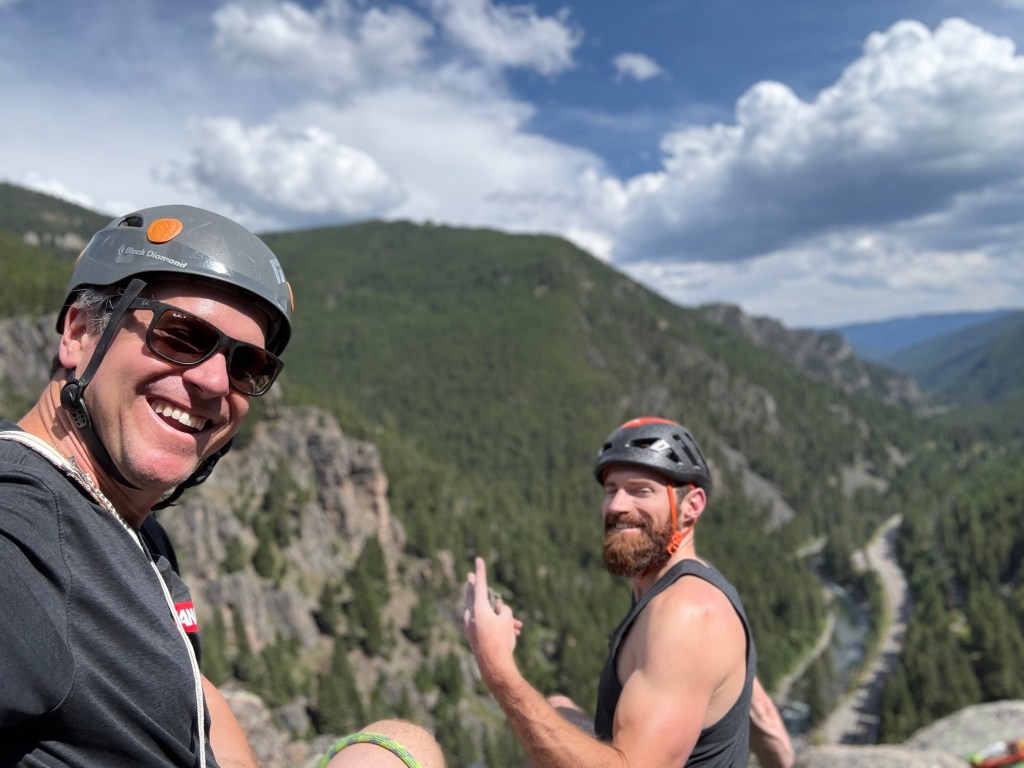
The Guide Route was good, and we want more. We settle on climbing the Standard Route. I know this route will humble us even as I approach it casually, too casually. Ryan is getting back into climbing and I have some of my own challenges today–occasional stabbing knee pains, slow reflexes, and a partially healed tibia after my severe leg break 7 months ago. Nevertheless, I know I will need to lead the 150′-long 5.8+ trad pitch. That grade brings pressure; even though the holds are good, they may not be great, and none of the potential falls will be clean.
Ryan cruises up the first pitch and establishes the belay. It’s perfect climbing, really: big blocky steps, juggy laybacks, and fist sized cracks in bulletproof gneiss. It’s safe to say that he enjoys this pitch. I have a comfy time following him up on top rope, and I revel in the feeling of good holds and the meat of my palm pressing into cool rock in perfect hand jams. Feeling the grit of the rock grounds me and brings me to the present moment. At the belay station, I grab handfuls of nuts, cams, and alpine draws off his harness, quickly clipping them to mine. I have a double rack of cams because the next pitch is a rope stretcher centering on a flaring crack system that eats cams but spits out nuts. As I rack up, I miss three draws on his harness, which I regretted later as my gear dwindled.
This next pitch is tried and true trad climbing. In many places, I start feeling run out and I find tensioned stances to plug gear–I can ease into comfier stances on smaller holds once I feel well protected. Then I can shake out, and continue on my way up. Along the way, I jam my body into a number of unkind positions and places, working my muscles against the rock. There’s such a strong dichotomy in grading between extremely hard sport routes on vertical stone with good protection compared to gnarly sandbagged trad routes like this one: despite their softer grade, they’re so much scarier.
I resume the sharp end for the final pitch up a chimney that splits open a roof above our position. Once I’ve gained the chimney I find good holds for my feet and press my back into the wall for security. My protection, five feet below me, does nothing to assuage the stress of hanging in free space twenty feet above a pile of ledges and boulders. I hastily jam in a green cam near my chest and clip to it as Ryan shouts up to me, “it’s starting to rain!” The cam is unlikely to walk and I don’t extend the clip with a sling, favoring a push through the final moves and up onto the ledge above, where the skies open up and water pours forth. The rain has been coming fast and hard this time of year.
Rain washes against Gallatin Tower. I look onwards to watch a large, swirling storm system roil between the canyon walls. Cloud ribbons coil their way down to the river. The thousand foot tall sheets of rain slide along wind currents and occasionally blow straight into us. My elevated view gives me a three dimensional perspective of this living, breathing storm. At this point, the water feels warm to me and I briefly savor my experience despite the danger these elements bring. After a few lightning strikes, things calm down and the skies clear up.
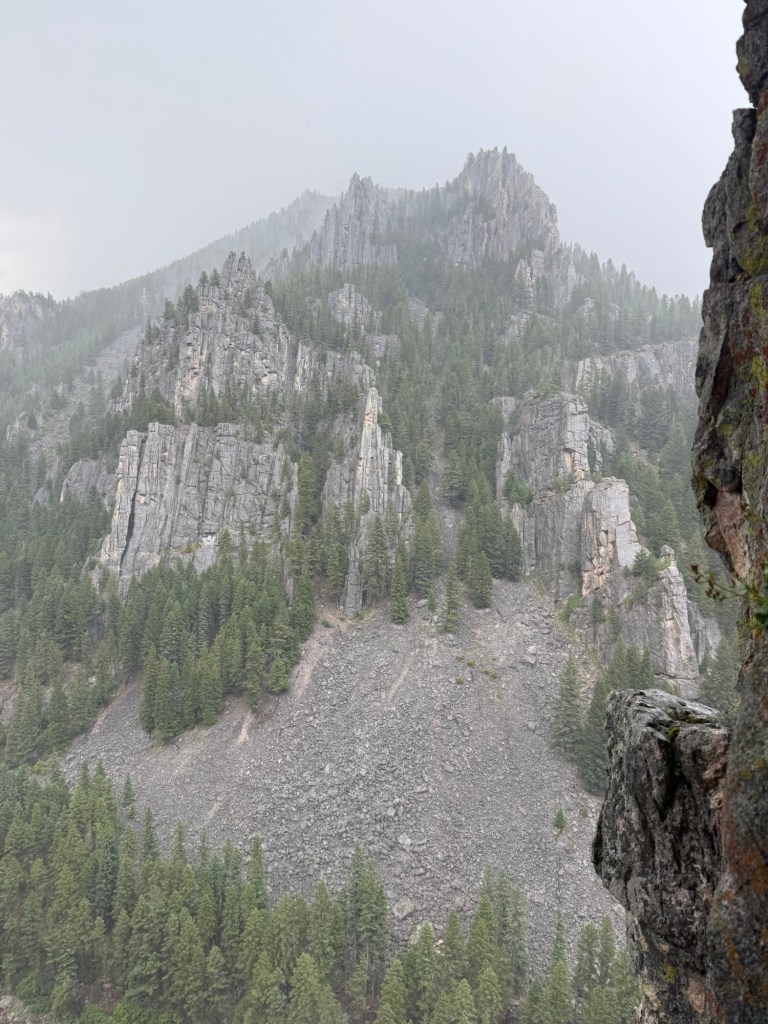
It seems to me that our quickest way out of this situation will be taking the familiar double rappel off the backside of the tower. This means we must keep going up. I make my way through the last ten feet of extremely wet and slippery climbing. I place gear every three feet in case I pop off a hold unexpectedly.
Now, the rain begins again in earnest. I set up a stout anchor for Ryan. We shout at each other and words can’t be made out but we understand the cadence and ritual of our acts, which give meaning to the muddled shouts that were likely to be: “Off Belay, Ryan.” “Asa: Belay is off.” “That’s me, Asa!” “You’re on belay, Ryan.” “Climbing!” “Climb on!” and “This is f**ing nuts man!” as Ryan begins to swim his way up greasy rock.
Summiting the tower, we make our way to the rappel station. “It’s starting to hail…” I observe with little emotion. Ice nuggets mix in with the rapidly cooling water cascading over us. Our shaking fingers and chattering jaws carry us through the motions of untangling soggy, reluctant rope, and threading it through the rappel rings. The rope is pretty tangled because…of course it is! Because of Murphey’s Law. I motion for Ryan to go down first and then I do not leave this spot for several long minutes while I wait and try to protect myself.
I hold still up there, crouched down on top of Gallatin Tower, my back is turned against the onslaught. Ice ricochets off my climbing helmet with loud snaps. Lighting and thunder become trivial: perhaps it was there, perhaps not. I shield my neck with my hands. The hail gets larger and I see one-half inch diameter ice pellets slam into my ten foot wide rock perch and bounce around like some crazy dance. The ice begins to bruise my knuckles. I turn my hand over and protect myself with my palm facing up–complete subservience to the heavens. I’m getting absolutely blasted up here. If the hail gets any larger I’m in a really bad position. “Hail storms are usually short, aren’t they, aren’t they?” I ask myself twice before giving up that line of thought.
Brief moments draw out. I wonder about the path that led me here and about the meaning of this moment. I try to rationalize my experience but quickly realize I can’t understand it. This moment simply *is* and I lean into this moment with acceptance and a will to endure. This level of immediacy and exposure to danger is not new to me. I’ll reflect on better preparation later.
Extreme danger reveals a lot about people and in a potentially devastating manner, but I learn that Ryan has a very good head on him and he executes his rappel flawlessly. Now it’s my turn to go down.
The rope is stretchy and heavy. I try to make sure it goes over the edge in a place it won’t get stuck in a crack but I’m feeling really bad about getting our rope down. Getting it stuck would be heartbreaking because we still needed to complete another rappel after this one. However, I don’t fuss with the rope any more because it’s too dangerous to spend more time up here and I need to leave. I’m overjoyed bailing off the side of the tower and out of the most severe exposure.
Waves of chill pass through our bodies between the rappels. Our first attempts to pull the rope down are fruitless, I’m starting to think that the rope won’t come down at all and wonder if there’s an alternate walk off from here. Fortunately, Ryan keeps working on the rope, finds another angle to pull from, and soon we’re making arm lengths of progress at a time–two grown men putting all their weight into it. The physical exertion brings wonderful warmth to our arms and hands.
We rig up the last rappel and this time I get to go first. The cold is constricting my vision, making it hard to see where I’m headed. I keep blinking and squinting my eyes. But I’m not worried because my hands feel secure on the rope tails. And then I touch the ground and my spirits are lifted with relief. Ryan reaching the ground is even better. I don’t even care if the rope is stuck at this point but we manage to get it down anyways.
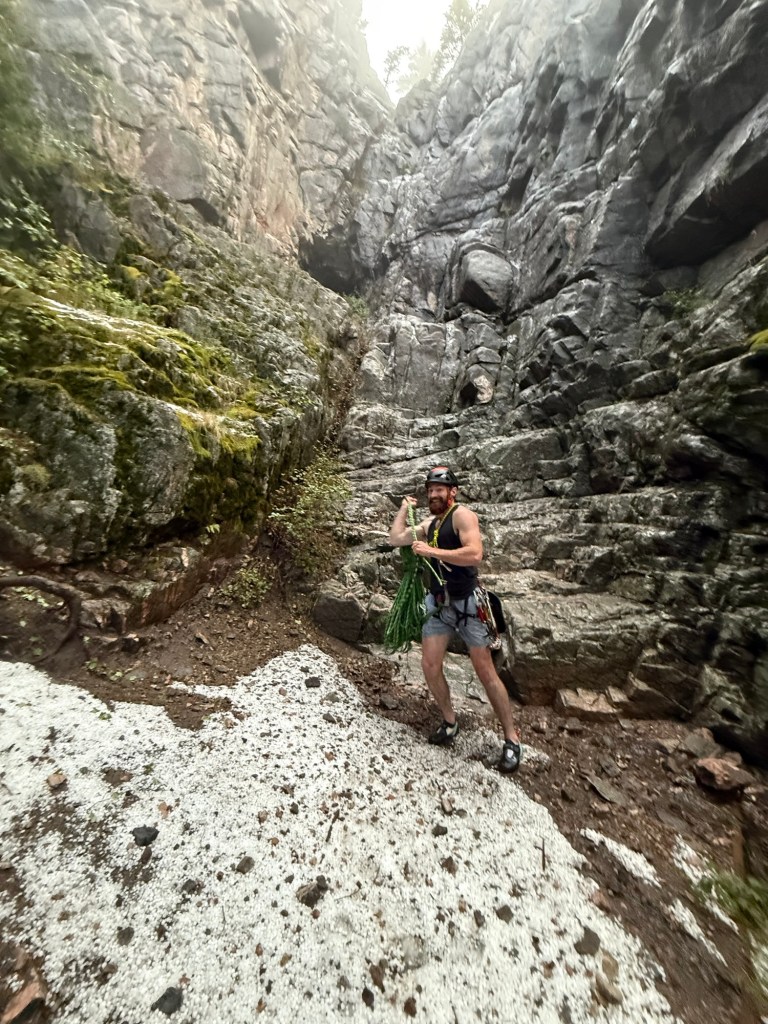
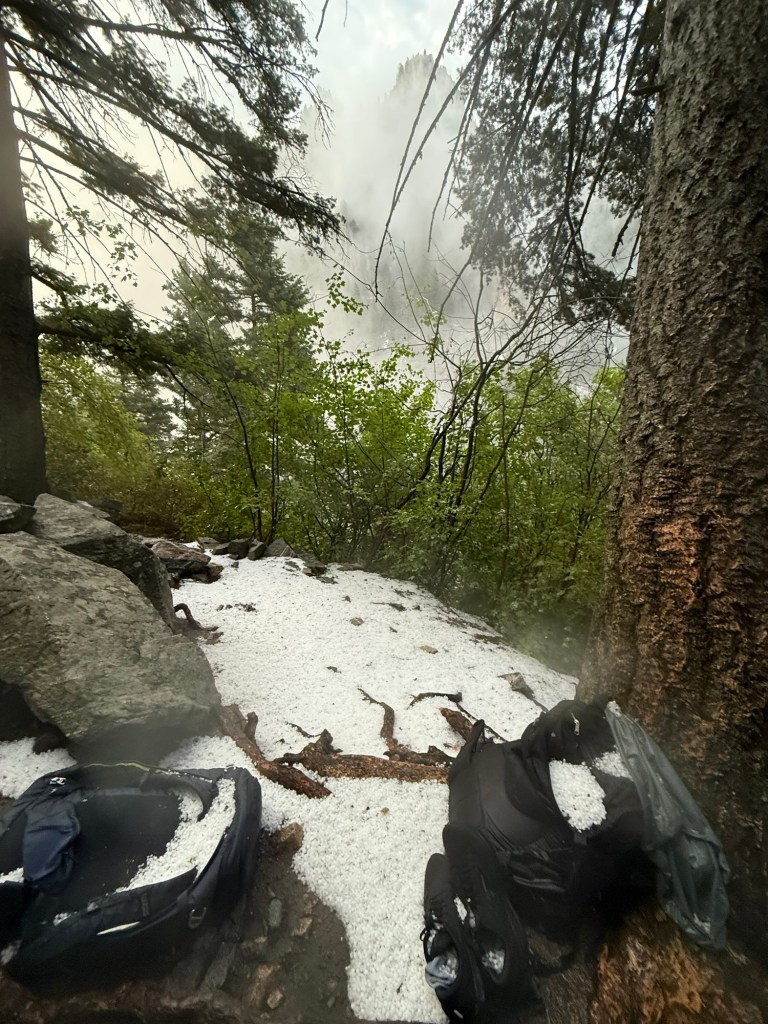
Our packs at the base are full of hail and ice water. For the first time ever, I opt to stay in my undersized, downturned climbing shoes all the way back to the truck. Ryan puts on tennis shoes and discovers one last treat: the toes are packed with hail. When I finally try to put on my flip flops, after several failed attempts, I must look down at my feet to make sure my shoes go on all the way because I don’t have enough sensation in my feet to tell otherwise.
We high-five at the road and a passer-by snaps a picture of us descending out of the maelstrom aftermath. I feel exhausted, accomplished, and pleased to be alive, and I feel that any bad karma I may have had was surely purged by the hail on top of the tower. This is type III fun epitomized and I’m glad to have a good comrade to get through it with.
 Asa Space